MOOS-IvP
- HomePage
- Software Download
- Release Notes
- Sponsors
- Dev Notes By Date
- Dev Notes By Module
- Recent Users
- MOOS-IvP@github
- MOOS@github
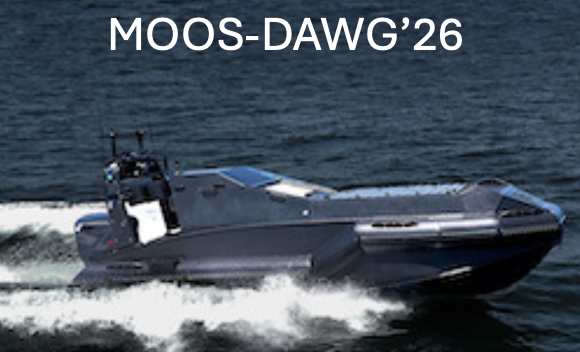
MOOS-DAWG'26
July 29-30 2026
Cambridge MA
MOOS-IvP Core Modules
- Oxford MOOS
- Core Autonomy
- Helm Behaviors
- Simulation
- Mission Control
- ALog Toolbox
- uField Toolbox
- General Utility
- IvP Benchmark
- Libraries
- All Alphabetically
Third Party Software MOOS-IvP Extensions
- LAMSS (MIT/MechE)
- 2.680 Course Modules
- Mission Systems
- blkSAIL
- GobySoft
- Hydroman Toolbox
- MIT Sea Grant AUV Lab
- Project Ladon
- moos-ivp-cc
- moos-ivp-iver
Extending MOOS-IvP
Documentation
SUPPORT
(:notitlegroup:)
   @article{wang2009,
    title     = {Acoustically Focused Adaptive Sampling and On-Board Routing for Marine Rapid
                Environmental Assessment},
    author    = {Ding Wang and Pierre F.J Lermusiaux and Patrick J. Haley and Donald Eickstedt
                 and Wayne G. Leslie and Henrik Schmidt},
    journal   = {Journal of Marine Systems},
    pages     = {S393 - S407},
    volume    = {78, Supplement},
    year      = {2009},
    abstract  = {Variabilities in the coastal ocean environment span a wide range of spatial
                and temporal scales. From an acoustic viewpoint, the limited oceanographic
                measurements and today's ocean computational capabilities are not always able
                to provide oceanic-acoustic predictions in high-resolution and with enough
                accuracy. Adaptive Rapid Environmental Assessment (AREA) is an adaptive
                sampling concept being developed in connection with the emergence of
                Autonomous Ocean Sampling Networks and interdisciplinary ensemble predictions
                and adaptive sampling via Error Subspace Statistical Estimation (ESSE). By
                adaptively and optimally deploying in situ sampling resources and assimilating
                these data into coupled nested ocean and acoustic models, (AREA) can
                dramatically improve the estimation of ocean fields that matter for acoustic
                predictions. These concepts are outlined and a methodology is developed and
                illustrated based on the Focused Acoustic Forecasting-05 (FAF05) exercise in
                the northern Tyrrhenian sea. The methodology first couples the
                data-assimilative environmental and acoustic propagation ensemble modeling. An
                adaptive sampling plan is then predicted, using the uncertainty of the
                acoustic predictions as input to an optimization scheme which finds the
                parameter values of autonomous sampling behaviors that optimally reduce this
                forecast of the acoustic uncertainty. To compute this reduction, the expected
                statistics of unknown data to be sampled by different candidate sampling
                behaviors are assimilated. The predicted-optimal parameter values are then fed
                to the sampling vehicles. A second adaptation of these parameters is
                ultimately carried out in the water by the sampling vehicles using onboard
                routing, in response to the real ocean data that they acquire. The autonomy
                architecture and algorithms used to implement this methodology are also
                described. Results from a number of real-time (AREA) simulations using data
                collected during the Focused Acoustic Forecasting (FAF05) exercise are
                presented and discussed for the case of a single Autonomous Underwater Vehicle
                (AUV). For FAF05, the main AREA ESSE application was the optimal tracking of
                the ocean thermocline based on ocean-acoustic ensemble prediction, adaptive
                sampling plans for vertical Yo-Yo behaviors and subsequent onboard Yo-Yo
                routing.}}