MOOS-IvP
- HomePage
- Software Download
- Release Notes
- Sponsors
- Dev Notes By Date
- Dev Notes By Module
- Recent Users
- MOOS-IvP@github
- MOOS@github
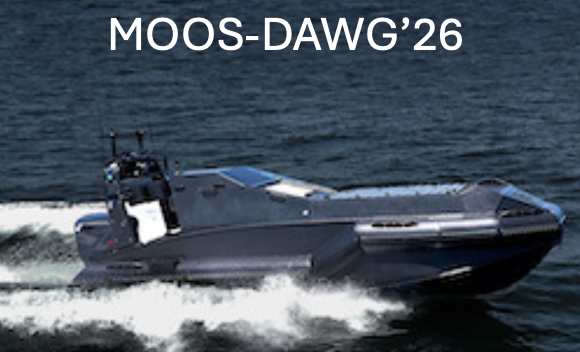
MOOS-DAWG'26
July 29-30 2026
Cambridge MA
MOOS-IvP Core Modules
- Oxford MOOS
- Core Autonomy
- Helm Behaviors
- Simulation
- Mission Control
- ALog Toolbox
- uField Toolbox
- General Utility
- IvP Benchmark
- Libraries
- All Alphabetically
Third Party Software MOOS-IvP Extensions
- LAMSS (MIT/MechE)
- 2.680 Course Modules
- Mission Systems
- blkSAIL
- GobySoft
- Hydroman Toolbox
- MIT Sea Grant AUV Lab
- Project Ladon
- moos-ivp-cc
- moos-ivp-iver
Extending MOOS-IvP
Documentation
SUPPORT
(:notitlegroup:)
   @inproceedings{schmidt2016icex,
    title     = {Acoustic Communication and Navigation in the New Arctic; A Model Case for
                Environmental Adaptation},
    booktitle = {2016 IEEE Third Underwater Communications and Networking Conference (UComms)},
    author    = {Henrik Schmidt and Toby Schneider},
    pages     = {1-4},
    month     = {August},
    year      = {2016},
    keywords  = {climate mitigation;marine navigation;tracking;underwater acoustic
                communication;Arctic sensitivity;Beaufort sea;ICEX16 US Navy
                Exercise;MIT;acoustic communication;acoustic sensing;autonomous underwater
                vehicle;climate change;environmental adaptation;ice cover;navigation;onboard
                inertial navigation;robust acoustic connectivity;submarine tracking
                range;towed hydrophone array;undersea ambient noise environment;underwater
                operation;warm Pacific water;Acoustics;Adaptation
                models;Arctic;Ducts;Ice;Navigation;Propagation losses},
    abstract  = {The particular sensitivity of the Arctic to climate change is well
                established, and the significance to undersea operations can be dramatic. As
                part of the recent ICEX16 US Navy Exercise in the Beaufort Sea, MIT deployed
                an autonomous underwater vehicle with a towed hydrophone array below the ice
                cover for assessing the climate induced changes to the undersea ambient noise
                environment. The safe underwater operation depended on navigation updates from
                the submarine tracking range being communicated to the vehicle for fusion with
                the onboard inertial navigation. However, the changes in the environment
                severely deteriorated the tracking performance compared to previous
                deployments. The reason was clearly associated with a previously observed
                neutrally bouyant layer of warm Pacific water persistently spreading
                throughout the Beaufort Sea, which severely alters the acoustic environment
                with dramatic effects for both long and short range acoustic sensing,
                communication and navigation. This paper describes the effects observed and
                discusses how robust acoustic connectivity in this environment makes it
                paramount that the manned or unmanned undersea platforms are capable of
                adapting to the environment for sensing, communication and navigation.}}