MOOS-IvP
- HomePage
- Software Download
- Release Notes
- Sponsors
- Dev Notes By Date
- Dev Notes By Module
- Recent Users
- MOOS-IvP@github
- MOOS@github
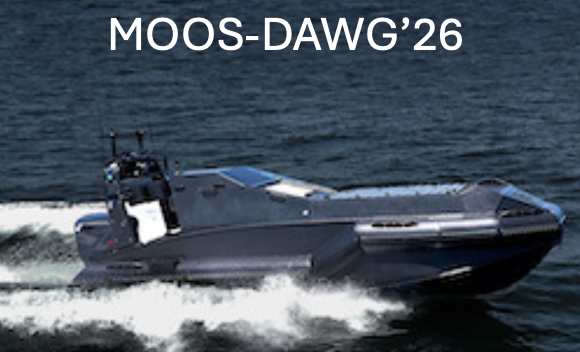
MOOS-DAWG'26
July 29-30 2026
Cambridge MA
MOOS-IvP Core Modules
- Oxford MOOS
- Core Autonomy
- Helm Behaviors
- Simulation
- Mission Control
- ALog Toolbox
- uField Toolbox
- General Utility
- IvP Benchmark
- Libraries
- All Alphabetically
Third Party Software MOOS-IvP Extensions
- LAMSS (MIT/MechE)
- 2.680 Course Modules
- Mission Systems
- blkSAIL
- GobySoft
- Hydroman Toolbox
- MIT Sea Grant AUV Lab
- Project Ladon
- moos-ivp-cc
- moos-ivp-iver
Extending MOOS-IvP
Documentation
SUPPORT
(:notitlegroup:)
   @inproceedings{novitzky2012,
    title     = {Bio-inspired multi-robot communication through behavior recognition},
    booktitle = {2012 IEEE International Conference on Robotics and Biomimetics (ROBIO)},
    author    = {Michael Novitzky and Charles Pippin and Thomas R. Collins and Tucker R. Balch
                 and Michael E. West},
    pages     = {771-776},
    month     = {December},
    year      = {2012},
    keywords  = {autonomous underwater vehicles;mobile communication;multi-robot
                systems;trajectory control;weapons;ASV;AUV;CRF;MLO;acoustic
                communication;autonomous surface vehicle;autonomous underwater
                vehicle;behavior recognition;bioinspired multirobot communication;conditional
                random fields;cooperative task;food source;honey bee waggle dance;mine
                clearing task;mine-like objects;multirobot teams;radio communication;teammate
                action sequences;trajectory based techniques},
    abstract  = {This paper focuses on enabling multi-robot teams to cooperatively perform
                tasks without the use of radio or acoustic communication. One key to more
                effective cooperative interaction in a multi-robot team is the ability to
                understand the behavior and intent of other robots. This is similar to the
                honey bee “waggle dance” in which a bee can communicate the orientation
                and distance of a food source. In this similar manner, our heterogenous
                multi-robot team uses a specific behavior to indicate the location of
                mine-like objects (MLOs). Observed teammate action sequences can be learned to
                perform behavior recognition and task-assignment in the absence of
                communication. We apply Conditional Random Fields (CRFs) to perform behavior
                recognition as an approach to task monitoring in the absence of communication
                in a challenging underwater environment. In order to demonstrate the use of
                behavior recognition of an Autonomous Underwater Vehicle (AUV) in a
                cooperative task, we use trajectory based techniques for model generation and
                behavior discrimination in experiments using simulated scenario data. Results
                are presented demonstrating heterogenous teammate cooperation between an AUV
                and an Autonomous Surface Vehicle (ASV) using behavior recognition rather than
                radio or acoustic communication in a mine clearing task.}}