MOOS-IvP
- HomePage
- Software Download
- Release Notes
- Sponsors
- Dev Notes By Date
- Dev Notes By Module
- Recent Users
- MOOS-IvP@github
- MOOS@github
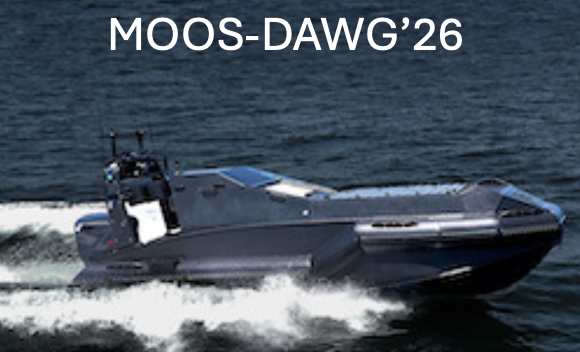
MOOS-DAWG'26
July 29-30 2026
Cambridge MA
MOOS-IvP Core Modules
- Oxford MOOS
- Core Autonomy
- Helm Behaviors
- Simulation
- Mission Control
- ALog Toolbox
- uField Toolbox
- General Utility
- IvP Benchmark
- Libraries
- All Alphabetically
Third Party Software MOOS-IvP Extensions
- LAMSS (MIT/MechE)
- 2.680 Course Modules
- Mission Systems
- blkSAIL
- GobySoft
- Hydroman Toolbox
- MIT Sea Grant AUV Lab
- Project Ladon
- moos-ivp-cc
- moos-ivp-iver
Extending MOOS-IvP
Documentation
SUPPORT
(:notitlegroup:)
   @article{murphy2014,
    title     = {CAPTURE: A Communications Architecture for Progressive Transmission via
                Underwater Relays With Eavesdropping},
    author    = {Chris Murphy and Jeffrey M. Walls and Toby Schneider and Ryan M. Eustice and
                 Milica Stojanovic and Hanumant Singh},
    journal   = {IEEE Journal of Oceanic Engineering},
    pages     = {120-130},
    number    = {1},
    volume    = {39},
    month     = {January},
    year      = {2014},
    keywords  = {autonomous underwater vehicles;oceanographic equipment;relay networks
                (telecommunication);sonar;telecommunication security;underwater acoustic
                telemetry;Bluefin AUV;CAPTURE;OceanServer;SeaBED;autonomous marine
                vehicles;communications architecture;eavesdropping;end-to-end networking
                solution;imagery data;multihop communication across;progressive
                transmission;software architectures;sonar data;time-series sensor
                data;underwater acoustic relay;underwater relay;unmanned underwater
                vehicle;Acoustics;Encoding;Image coding;Image reconstruction;Modems;Sea
                surface;Vehicles;Aquatic robots;disruption tolerant networking;underwater
                communication;unmanned underwater vehicles (UUVs)},
    abstract  = {As analysis of imagery and other science data plays a greater role in mission
                execution, there is an increasing need for autonomous marine vehicles to
                transmit these data to the surface. Communicating imagery and full-resolution
                sensor readings to surface observers remains a significant challenge. Yet,
                without access to the data acquired by an unmanned underwater vehicle (UUV),
                surface operators cannot fully understand the mission state of a vehicle. This
                paper presents an architecture capable of multihop communication across a
                network of underwater acoustic relays. In concert with an abstracted physical
                layer, CAPTURE provides an end-to-end networking solution for communicating
                science data from autonomous marine vehicles. Automatically selected imagery,
                SONAR, and time-series sensor data are progressively transmitted across
                multiple hops to surface operators. To incorporate human feedback, data are
                transmitted as a sequence of gradually improving data “previews.”
                Operators can request arbitrarily high-quality refinement of any resource, up
                to an error-free reconstruction. The results of three diverse field trials on
                SeaBED, OceanServer, and Bluefin AUVs, with drastically different software
                architectures, are also presented.}}