MOOS-IvP
- HomePage
- Software Download
- Release Notes
- Sponsors
- Dev Notes By Date
- Dev Notes By Module
- Recent Users
- MOOS-IvP@github
- MOOS@github
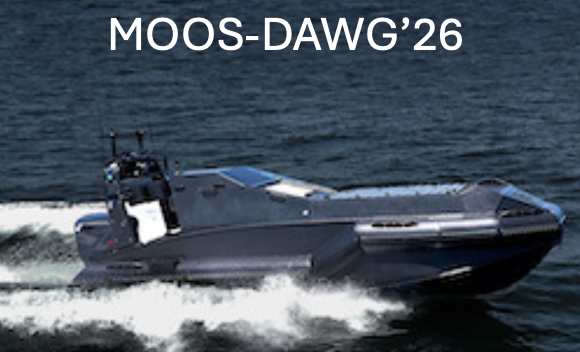
MOOS-DAWG'26
July 29-30 2026
Cambridge MA
MOOS-IvP Core Modules
- Oxford MOOS
- Core Autonomy
- Helm Behaviors
- Simulation
- Mission Control
- ALog Toolbox
- uField Toolbox
- General Utility
- IvP Benchmark
- Libraries
- All Alphabetically
Third Party Software MOOS-IvP Extensions
- LAMSS (MIT/MechE)
- 2.680 Course Modules
- Mission Systems
- blkSAIL
- GobySoft
- Hydroman Toolbox
- MIT Sea Grant AUV Lab
- Project Ladon
- moos-ivp-cc
- moos-ivp-iver
Extending MOOS-IvP
Documentation
SUPPORT
(:notitlegroup:)
   @inproceedings{moore2015,
    title     = {Artemis AUV Payload Development},
    booktitle = {OCEANS 2015 - MTS/IEEE Washington},
    author    = {Chris Moore and Peter McKibbin},
    pages     = {1-3},
    month     = {October},
    year      = {2015},
    keywords  = {autonomous underwater vehicles;control engineering
                computing;magnetometers;public domain software;AUV payload computer;Artemis
                AUV payload development;MOOS-IvP software;Mission Oriented Operating Suite -
                Interval Programming;Phoenix engineers;Phoenix operators;autonomous underwater
                vehicle;magnetometer payload;open source C++ module;seafloor mineral
                location;seafloor mineral mapping;Computers;Magnetic sensors;Magnetic
                separation;Magnetometers;Payloads;Vehicles;AUV;Artemis; Autonomy},
    abstract  = {Phoenix engineers and operators have been working on developing new payload
                capabilities for our Autonomous Underwater Vehicle (AUV) Artemis. Initially,
                we integrated and demonstrated a payload designed to look for hydro-carbon
                leaks from subsea pipelines. More recently, we developed a magnetometer
                payload for locating and mapping seafloor minerals. Both of these efforts
                involve the use of an AUV payload computer and a set of open source C++
                modules for providing autonomy on robotic platforms, in particular autonomous
                marine vehicles, called Mission Oriented Operating Suite - Interval
                Programming (MOOS-IvP). This paper will discuss these AUV payload development
                efforts and describe how Artemis is now ready to support additional payload
                development initiatives.}}