MOOS-IvP
- HomePage
- Software Download
- Release Notes
- Sponsors
- Dev Notes By Date
- Dev Notes By Module
- Recent Users
- MOOS-IvP@github
- MOOS@github
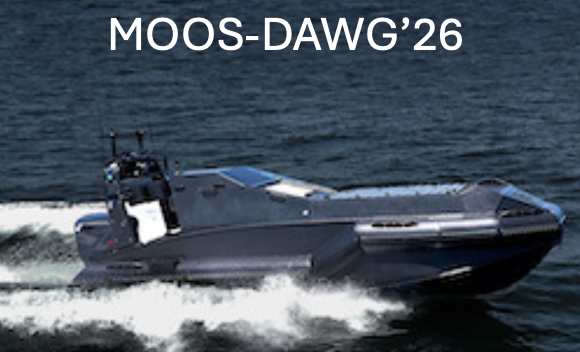
MOOS-DAWG'26
July 29-30 2026
Cambridge MA
MOOS-IvP Core Modules
- Oxford MOOS
- Core Autonomy
- Helm Behaviors
- Simulation
- Mission Control
- ALog Toolbox
- uField Toolbox
- General Utility
- IvP Benchmark
- Libraries
- All Alphabetically
Third Party Software MOOS-IvP Extensions
- LAMSS (MIT/MechE)
- 2.680 Course Modules
- Mission Systems
- blkSAIL
- GobySoft
- Hydroman Toolbox
- MIT Sea Grant AUV Lab
- Project Ladon
- moos-ivp-cc
- moos-ivp-iver
Extending MOOS-IvP
Documentation
SUPPORT
(:notitlegroup:)
   @article{mcmahon2017,
    title     = {Autonomous Data Collection With Limited Time for Underwater Vehicles},
    author    = {James McMahon and Erion Plaku},
    journal   = {IEEE Robotics and Automation Letters},
    pages     = {112-119},
    number    = {1},
    volume    = {2},
    month     = {January},
    year      = {2017},
    keywords  = {autonomous underwater vehicles;path planning;sampling methods;vehicle
                dynamics;autonomous data collection;collision-free planning;constraint-based
                solvers;dynamic feasible trajectory;motion tree;sampling-based motion
                planning;time-varying ocean currents;underwater vehicles;vehicle
                dynamics;Navigation;Oceans;Planning;Trajectory;Upper bound;Vehicle
                dynamics;Vehicles;Marine Robotics;Marine robotics;Motion and Path
                Planning;motion and path planning},
    abstract  = {This paper studies the problem of autonomous data collection where an
                underwater vehicle is required to reach several target regions within a
                specified time limit. The proposed approach takes into account the vehicle
                dynamics, the time-varying ocean currents, and the obstacles in the region in
                order to effectively plan a collision-free and dynamically feasible trajectory
                whose time duration does not exceed the time limit. When the time limit makes
                it impossible to reach every target, the approach seeks to reduce the penalty
                accrued by the target regions that are not visited. The approach combines
                sampling-based motion planning with constraint-based solvers. In fact, a
                constraint-based solver searches a navigation roadmap to compute bounded tours
                which minimize the accrued penalty. Sampling-based motion planning is then
                used to expand a motion tree along these tours. Unsuccessful tour expansions
                are penalized to promote exploration of alternative tours. Simulation and
                field experiments demonstrate the efficiency of the approach in planning
                collision-free and dynamically feasible trajectories that reduce the accrued
                penalty.}}