MOOS-IvP
- HomePage
- Software Download
- Release Notes
- Sponsors
- Dev Notes By Date
- Dev Notes By Module
- Recent Users
- MOOS-IvP@github
- MOOS@github
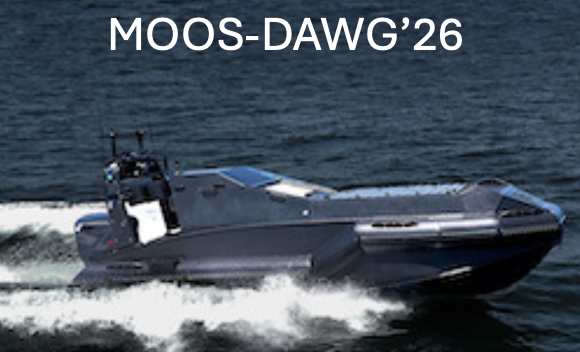
MOOS-DAWG'26
July 29-30 2026
Cambridge MA
MOOS-IvP Core Modules
- Oxford MOOS
- Core Autonomy
- Helm Behaviors
- Simulation
- Mission Control
- ALog Toolbox
- uField Toolbox
- General Utility
- IvP Benchmark
- Libraries
- All Alphabetically
Third Party Software MOOS-IvP Extensions
- LAMSS (MIT/MechE)
- 2.680 Course Modules
- Mission Systems
- blkSAIL
- GobySoft
- Hydroman Toolbox
- MIT Sea Grant AUV Lab
- Project Ladon
- moos-ivp-cc
- moos-ivp-iver
Extending MOOS-IvP
Documentation
SUPPORT
(:notitlegroup:)
   @inproceedings{fischell2016,
    title     = {AUV Behaviors for Collection of Bistatic and Multistatic Acoustic Scattering
                Data from Seabed Targets},
    booktitle = {2016 IEEE International Conference on Robotics and Automation (ICRA)},
    author    = {Erin M. Fischell and Henrik Schmidt},
    pages     = {2645-2650},
    month     = {May},
    year      = {2016},
    keywords  = {acoustic wave scattering;autonomous underwater vehicles;image sensors;mobile
                robots;multi-robot systems;AUV behavior;acoustic source;aspect
                angle;autonomous underwater vehicle;bistatic acoustic scattering;bistatic
                angle;harbor security;hydrophone nose array;imaging sensor;mobile autonomous
                vehicle;multiple AUV;multistatic acoustic scattering;radiation pattern;seabed
                target;source frequency;target classification;target localization;vehicle
                dynamics constraint;Acoustic
                arrays;Acoustics;Arrays;Nose;Receivers;Scattering;Vehicles},
    abstract  = {Characterization of seabed targets using networks of Autonomous Underwater
                Vehicles (AUVs) is of great interest for harbor security. The imaging sensors
                generally used for target localization and classification are expensive for
                outfitting multiple AUVs and produce data that is difficult to use for
                real-time onboard classification. An approach to this problem has been
                developed in which an acoustic source insonifies targets and AUVs with
                inexpensive hydrophone nose arrays are used to sample the resulting scattered
                fields. These scattered fields consist of distinctive radiation patterns,
                where the amplitude sampled by a receiving AUV for a particular target is
                determined by source frequency, aspect angle between source and target, and
                bistatic angle between source and receiver. AUV behaviors were developed to
                control the bistatic angles relative to a localized target between source and
                receiver vehicles and aspect angle between a target and the source. Two
                configurations were explored: bistatic, where the source is fixed and receiver
                moving, and multistatic, where both source and receiver are located on mobile
                autonomous vehicles. Design considerations for behaviors to sample different
                combinations of bistatic angle and aspect angle included keeping receiving
                arrays broadside to a target for uniform-quality data collection and obeying
                vehicle dynamics constraints. Behaviors for the bistatic configuration were
                demonstrated in AUV experiments, and behaviors for the multistatic case were
                demonstrated in simulation, including collaboration between source and
                receiver vehicles for controlling bistatic versus aspect angle.}}