MOOS-IvP
- HomePage
- Software Download
- Release Notes
- Sponsors
- Dev Notes By Date
- Dev Notes By Module
- Recent Users
- MOOS-IvP@github
- MOOS@github
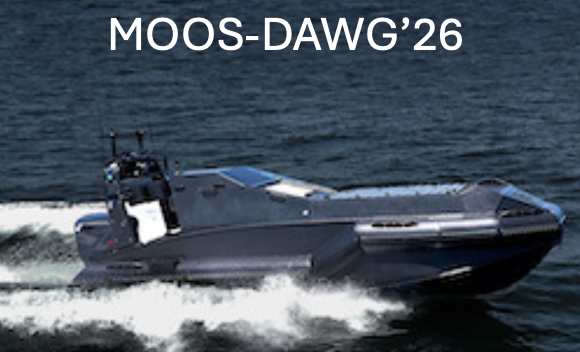
MOOS-DAWG'26
July 29-30 2026
Cambridge MA
MOOS-IvP Core Modules
- Oxford MOOS
- Core Autonomy
- Helm Behaviors
- Simulation
- Mission Control
- ALog Toolbox
- uField Toolbox
- General Utility
- IvP Benchmark
- Libraries
- All Alphabetically
Third Party Software MOOS-IvP Extensions
- LAMSS (MIT/MechE)
- 2.680 Course Modules
- Mission Systems
- blkSAIL
- GobySoft
- Hydroman Toolbox
- MIT Sea Grant AUV Lab
- Project Ladon
- moos-ivp-cc
- moos-ivp-iver
Extending MOOS-IvP
Documentation
SUPPORT
(:notitlegroup:)
   @inproceedings{ferri2016,
    title     = {A Data-Driven Control Strategy in Synergy With Continuous Active Sonar for
                Littoral Underwater Surveillance},
    booktitle = {OCEANS 2016 MTS/IEEE Monterey},
    author    = {Gabriele Ferri and Andrea Munafò and Joao Alves and Kevin LePage},
    pages     = {1-7},
    month     = {September},
    year      = {2016},
    keywords  = {autonomous underwater vehicles;mobile robots;sonar;telerobotics;video
                surveillance;CAS;CAS signal processing;MML;continuous active sonar;data driven
                control strategy;data driven mission management layer;littoral surveillance
                mission;littoral underwater surveillance;nonmyopic control algorithm;on-board
                AUV;prediction time window;target position estimation error;Signal
                processing;Signal processing algorithms;Sonar;Surveillance;Target
                tracking;Transducers;Vehicles},
    abstract  = {In this work, we describe a data-driven Mission Management Layer (MML) running
                on-board AUVs which manages the phases of a littoral surveillance mission and
                exploits the characteristics of Continuous Active Sonar (CAS) signal
                processing. The MML selects for further investigation the tracks which are
                likely originated by a target. In this case, the MML launches a receding
                horizon, non-myopic control algorithm which controls the AUV's heading to
                improve the tracking performance to ease the target classification. The
                algorithm minimises the expected target position estimation error over a
                prediction time window by achieving a trade-off amongst different objectives:
                keeping the target at broadside, reducing the distance to the target, avoiding
                areas of high reverberation and searching for geometric configurations with
                low bistatic target localisation error. We report at-sea experiments obtained
                during the LCAS15 sea trial, which demonstrated, for the first time, that the
                proposed autonomy architecture can be executed together with real-time
                Continuous Active Sonar (CAS) processing on-board the AUVs. CAS has recently
                gained interest for littoral Anti-Submarine Warfare, since it offers the
                promise of multiple detections per waveform cycle. This can potentially
                improve the quality/length of tracks, thus increasing the adaptive behaviour's
                performance, which, in turn, can increase the detection and tracking
                capabilities of the processing chain.}}