MOOS-IvP
- HomePage
- Software Download
- Release Notes
- Sponsors
- Dev Notes By Date
- Dev Notes By Module
- Recent Users
- MOOS-IvP@github
- MOOS@github
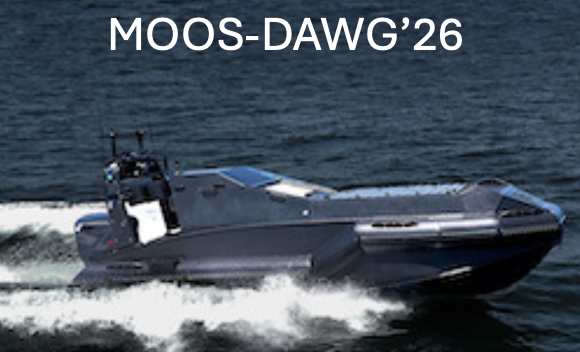
MOOS-DAWG'26
July 29-30 2026
Cambridge MA
MOOS-IvP Core Modules
- Oxford MOOS
- Core Autonomy
- Helm Behaviors
- Simulation
- Mission Control
- ALog Toolbox
- uField Toolbox
- General Utility
- IvP Benchmark
- Libraries
- All Alphabetically
Third Party Software MOOS-IvP Extensions
- LAMSS (MIT/MechE)
- 2.680 Course Modules
- Mission Systems
- blkSAIL
- GobySoft
- Hydroman Toolbox
- MIT Sea Grant AUV Lab
- Project Ladon
- moos-ivp-cc
- moos-ivp-iver
Extending MOOS-IvP
Documentation
SUPPORT
(:notitlegroup:)
   @inproceedings{ferri2014,
    title     = {Results From COLLAB13 Sea Trial on Tracking Underwater Targets With AUVs in
                Bistatic Sonar Scenarios},
    booktitle = {2014 Oceans - St. John's},
    author    = {Gabriele Ferri and Andrea Munafò and Ryan Goldhahn and Kevin LePage},
    pages     = {1-9},
    month     = {September},
    year      = {2014},
    keywords  = {autonomous aerial vehicles;control engineering computing;decision
                trees;filtering theory;middleware;optimisation;sonar tracking;target
                tracking;ASW;AUV;CMRE software system;COLLAB13 sea trial;MOOS-IvP
                middleware;antisubmarine warfare;bistatic sonar scenarios;computational
                intensive algorithms;decision tree;line array;littoral
                surveillance;multistatic network;nonmyopic strategy;optimization;realistic ASW
                scenarios;receding horizon strategy;receiver node;target state
                estimation;tracking filter;underwater target tracking;vehicle heading
                angles;Arrays;Covariance matrices;Decision trees;Optimization;Receivers;Target
                tracking;Vehicles},
    abstract  = {We describe the implementation of a novel non-myopic, receding horizon
                strategy to control the movement of an AUV towing a line array acting as a
                receiver node in a multistatic network for littoral surveillance and
                Anti-Submarine Warfare (ASW). The algorithm computes the vehicle heading
                angles to minimize the expected target position estimation error of a tracking
                filter. Minimizing this error is typically of the utmost interest in target
                state estimation since it is one way of maintaining track. The optimization
                solves a resulting decision tree taking into consideration a planning future
                horizon. In this paper, we focus on how to solve the different challenges
                related to the implementation of this kind of computational intensive
                algorithms on vehicles operating in realistic ASW scenarios and characterized
                by limited computational power. Specifically, we describe the multistatic
                network used in COLLAB13 experiments, how we simplify the solution of the
                resulting decision tree and the implementation of the algorithm in CMRE's
                software system running on AUVs and based on MOOS-IvP middleware. We conclude
                reporting results from COLLAB13 which demonstrate the feasibility to use the
                proposed algorithm in realistic operations onboard AUVs and its effectiveness
                over conventional predefined tracklines.}}