MOOS-IvP
- HomePage
- Software Download
- Release Notes
- Sponsors
- Dev Notes By Date
- Dev Notes By Module
- Recent Users
- MOOS-IvP@github
- MOOS@github
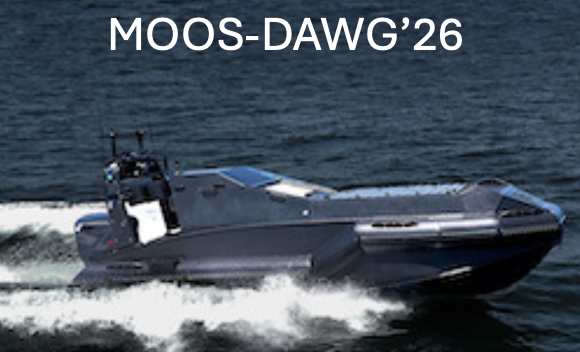
MOOS-DAWG'26
July 29-30 2026
Cambridge MA
MOOS-IvP Core Modules
- Oxford MOOS
- Core Autonomy
- Helm Behaviors
- Simulation
- Mission Control
- ALog Toolbox
- uField Toolbox
- General Utility
- IvP Benchmark
- Libraries
- All Alphabetically
Third Party Software MOOS-IvP Extensions
- LAMSS (MIT/MechE)
- 2.680 Course Modules
- Mission Systems
- blkSAIL
- GobySoft
- Hydroman Toolbox
- MIT Sea Grant AUV Lab
- Project Ladon
- moos-ivp-cc
- moos-ivp-iver
Extending MOOS-IvP
Documentation
SUPPORT
(:notitlegroup:)
   @inproceedings{bayat2016,
    title     = {Envirobot: A Bio-Inspired Environmental Monitoring Platform},
    booktitle = {2016 IEEE/OES Autonomous Underwater Vehicles (AUV)},
    author    = {Behzad Bayat and Alessandro Crespi and Auke Ijspeert},
    pages     = {381-386},
    month     = {November},
    year      = {2016},
    keywords  = {marine vehicles;microprocessor chips;mobile robots;ARM
                processor;Envirobot;Envirobot platform;aquatic environmental monitoring
                systems;autonomous marine vehicles;bioinspired environmental monitoring
                platform;data acquisition;environmental sensor integration;flexible
                computational power;long range communication link;micro processors;pollutant
                spills;remote mapping;remote sensing;spatial extent;Global Positioning
                System;Legged locomotion;Radio frequency;Autonomous marine
                vehicle;anguilliform swimming robot;environmental monitoring},
    abstract  = {Autonomous marine vehicles are becoming essential tools in aquatic
                environmental monitoring systems, and can be used for instance for data
                acquisition, remote sensing, and mapping of the spatial extent of pollutant
                spills. In this work, we present an unconventional bio-inspired autonomous
                robot aimed for execution of such tasks. The Envirobot platform is based on
                our existing segmented anguilliform swimming robots, but with important
                adaptations in terms of energy use and efficiency, control, navigation, and
                communication possibilities. To this end, Envirobot has been designed to have
                more endurance, flexible computational power, long range communication link,
                and versatile flexible environmental sensor integration. Its low level control
                is powered by an ARM processor in the head unit and micro processors in each
                active module. On top of this, integration of a computer-on-module enables
                versatile high level control methods. We present some preliminary results and
                experiments done with Envirobot to test the added navigation and control
                strategies.}}