MOOS-IvP
- HomePage
- Software Download
- Release Notes
- Sponsors
- Dev Notes By Date
- Dev Notes By Module
- Recent Users
- MOOS-IvP@github
- MOOS@github
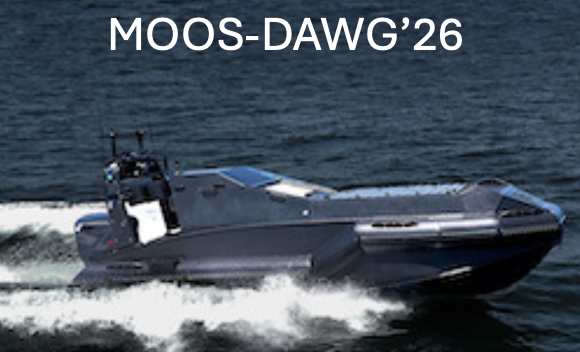
MOOS-DAWG'26
July 29-30 2026
Cambridge MA
MOOS-IvP Core Modules
- Oxford MOOS
- Core Autonomy
- Helm Behaviors
- Simulation
- Mission Control
- ALog Toolbox
- uField Toolbox
- General Utility
- IvP Benchmark
- Libraries
- All Alphabetically
Third Party Software MOOS-IvP Extensions
- LAMSS (MIT/MechE)
- 2.680 Course Modules
- Mission Systems
- blkSAIL
- GobySoft
- Hydroman Toolbox
- MIT Sea Grant AUV Lab
- Project Ladon
- moos-ivp-cc
- moos-ivp-iver
Extending MOOS-IvP
Documentation
SUPPORT
(:notitlegroup:)
   @inproceedings{balasuriya2010,
    title     = {Behavior-based planning and prosecution architecture for Autonomous Underwater
                Vehicles in Ocean Observatories},
    booktitle = {OCEANS 2010 IEEE - Sydney},
    author    = {Arjuna Balasuriya and Stephanie Petillo and Henrik Schmidt and Michael
                 Benjamin},
    pages     = {1-5},
    month     = {May},
    year      = {2010},
    keywords  = {oceanographic techniques;planning;time series;underwater acoustic
                communication;underwater vehicles;MOOS-IvP;adaptive sampling;autonomous
                underwater vehicles;backseat driver;behavior-based planning;gliders;hostile
                underwater environment;low-level control architecture;mission oriented object
                suite;mobile instruments;nested autonomy architecture;ocean
                observatory;optimization engine;prosecution architecture;time-series
                analysis;underwater communication infrastructure;Acoustics;Computer
                architecture;Mobile
                communication;Observatories;Oceans;Software;Vehicles;Autonomous Underwater
                Vehicles (AUVs);MOOS;MOOS DB;MOOS-IvP;OOI-CI;Underwater Gliders;behavior-based
                autonomy},
    abstract  = {This paper discusses the autonomy framework proposed for the mobile
                instruments such as Autonomous Underwater Vehicles (AUVs) and gliders. Paper
                focuses on the challenges faced by these clusters of mobile platform in
                executive tasks such as adaptive sampling in the hostile underwater
                environment. Collaborations between these mobile instruments are essential to
                capture the environmental changes and track them for time-series analysis.
                This paper looks into the challenges imposed by the underwater communication
                infrastructure and presents the nested autonomy architecture as a solution to
                overcome these challenges. The autonomy architecture is separated from the
                low-level control architecture of these instruments, which is called the
                `backseat driver'. The back-seat driver paradigm is implemented on the Mission
                Oriented Object Suite (MOOS) developed at MIT. The autonomy is achieved by
                generating multiple behaviors (multiple objective functions) linked to the
                internal state of the platform as well as the environment. Optimization engine
                called the MOOS-IvP is used to pick the best action for the given instance
                based on the mission at hand. At sea operational scenarios and results are
                presented to demonstrate the proposed autonomy architecture for Ocean
                Observatory Initiative (OOI).}}