Prev-Talk | Next-Talk | All-Talks | Talks-Sorted | MOOS-DAWG'26
Talk-09: A Simulation and Field Study Analysis of Cooperative Range-Aided Localization Strategies for Compact, Low-Cost AUV Teams
E. Gajski [1], R. Turrisi [1], J. Hong [1], J. Morrison [1], A. Papalia [3], E. Gallimore [2], M. Benjamin [1], J. Leonard [1]
[1] Department of Mechanical Engineering, Massachusetts Institute of Technology, Cambridge, MA 02139 USA. Email: egajski@mit.edu, rturrisi@mit.edu, jungseok@mit.edu, morrisjp@delaware.navy.mil, mikerb@mit.edu, jleonard@mit.edu
[2] Applied Ocean Physics and Engineering, Woods Hole Oceanographic Institution, Woods Hole, MA 02543 USA. Email: egallimore@whoi.edu
[3] Department of Naval Architecture and Marine Engineering, University of Michigan, Ann Arbor, MI 48109 USA. Email: apapalia@umich.edu
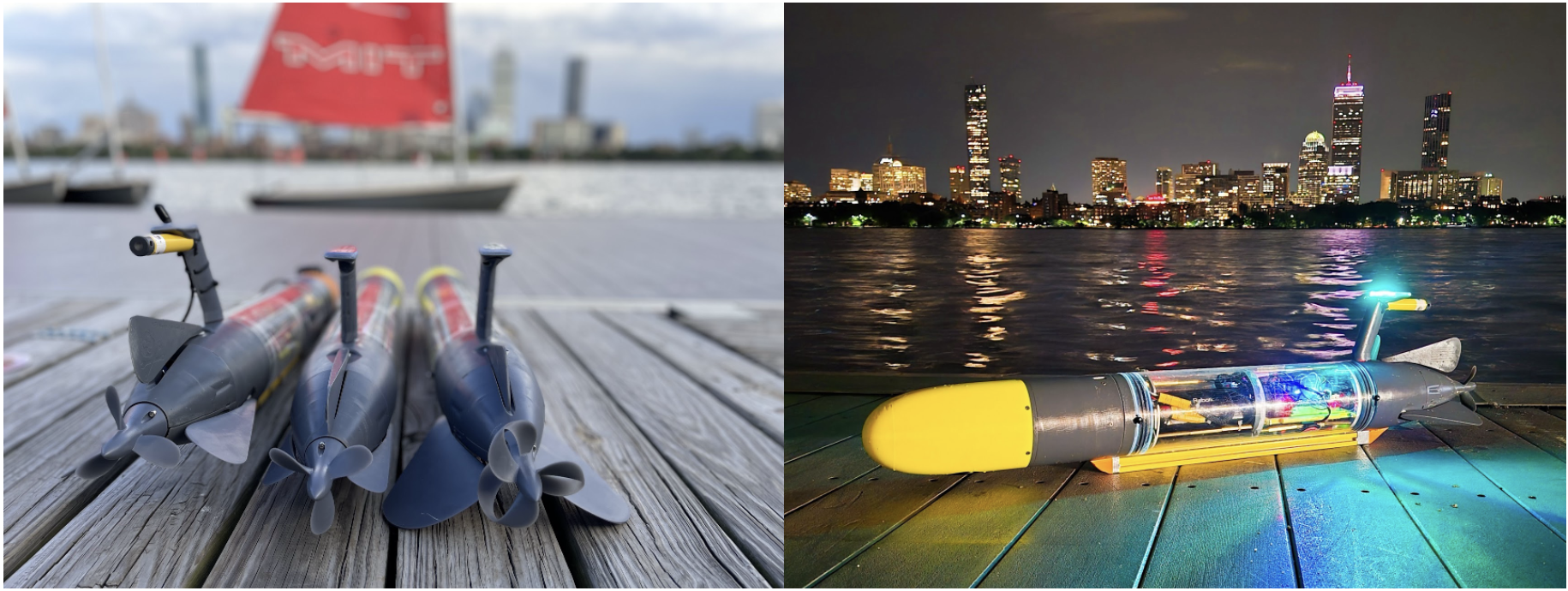
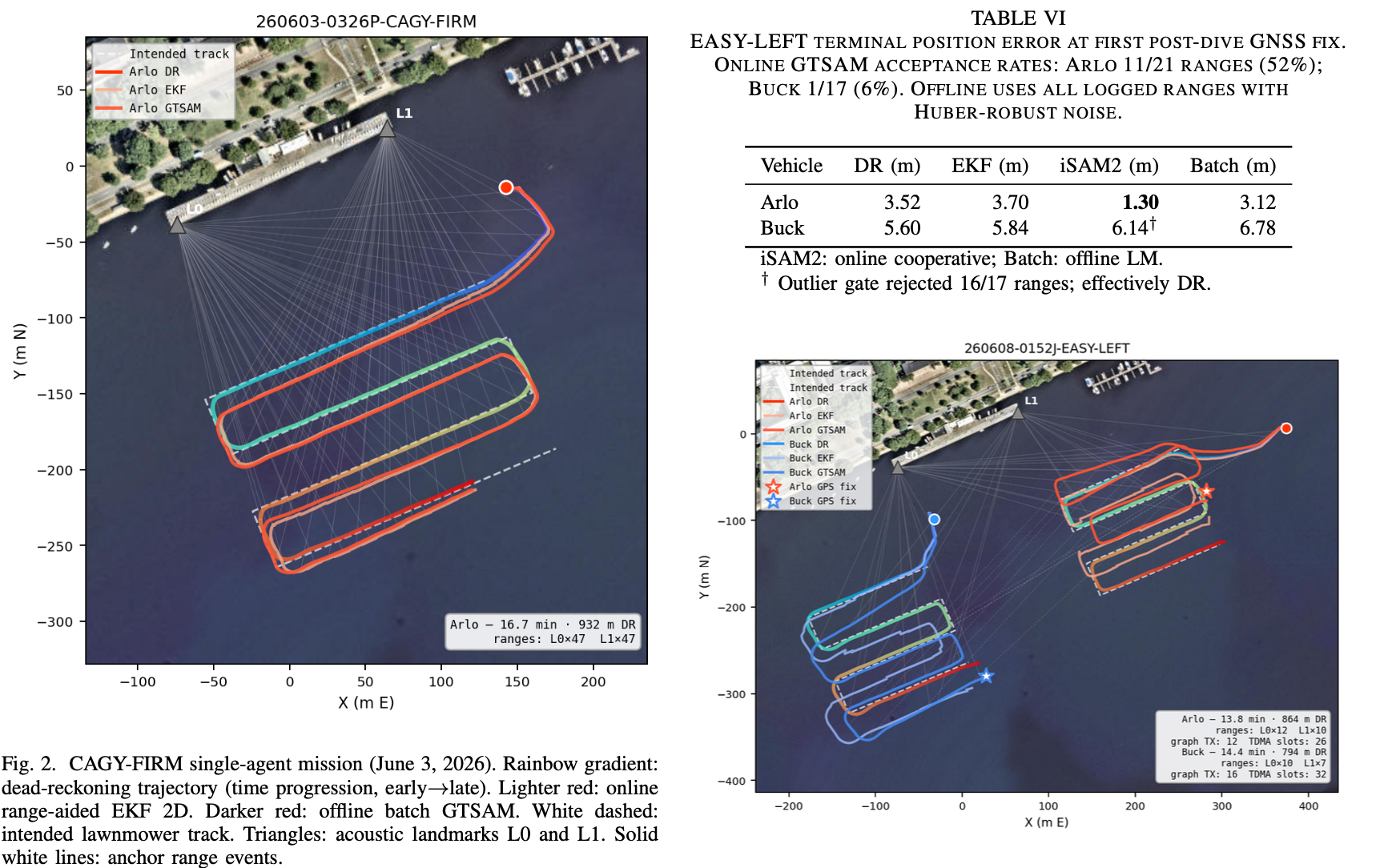
Accurate navigation for teams of autonomous underwater vehicles (AUVs) in GPS-denied environments is a prerequisite for persistent multi-vehicle operations, yet fixed acoustic infrastructure is costly to deploy and survey. Cooperative navigation offers an alternative: vehicles serve as mobile acoustic references for one another, eliminating the need for pre-surveyed seafloor transponders. This talk presents a simulation and field comparison of cooperative and non-cooperative range-aided estimators implemented within the MOOS-IvP autonomy architecture on compact, low-cost AUV hardware. Three localization strategies are evaluated in single- and multi-vehicle simulation: a range-aided EKF, an incremental factor graph optimizer (GTSAM-iSAM2 with landmark ranges), and a hybrid solver coupling iSAM2 with an EKF output layer. In two-vehicle scenarios, the factor graph methods extend to a cooperative configuration with the EKF as the non-cooperative baseline; cooperative iSAM2 matches baseline cross-track performance and improves it where inter-vehicle ranging compensates for poor landmark geometry. Field trials in the Charles River, conducted with the MIT Spurdog UUV, a compact, single-thruster, MOOS-IvP-based platform demonstrate live inter-vehicle acoustic ranging and online joint factor graph construction with two simultaneously submerged vehicles, achieving 1.30 m terminal error after 13.8 min submerged, showing sub-2 m GPS-denied accuracy is achievable on low-cost, field-deployable hardware using cooperative acoustic ranging alone.
Categories:
- UUVs
- Navigation
- Cooperative Autonomy
- iSAM2
- Spurdog