Prev-Talk | Next-Talk | All-Talks | Talks-Sorted | MOOS-DAWG'26
Talk-10: Next-Generation PEARL: A Floating Docking Platform for Marine and Aerial Vehicles
Prof. Oli de Weck, Jonathan Stoppani, Charles Benjamin, Victoria Cure Hurtado, Adam Phan, Afreen Siddiqi, Bill Chen, Sung Wook Paek, Julianna Dail
Department of Aeronautics and Astronautics, MIT Engineering and Systems Laboratory
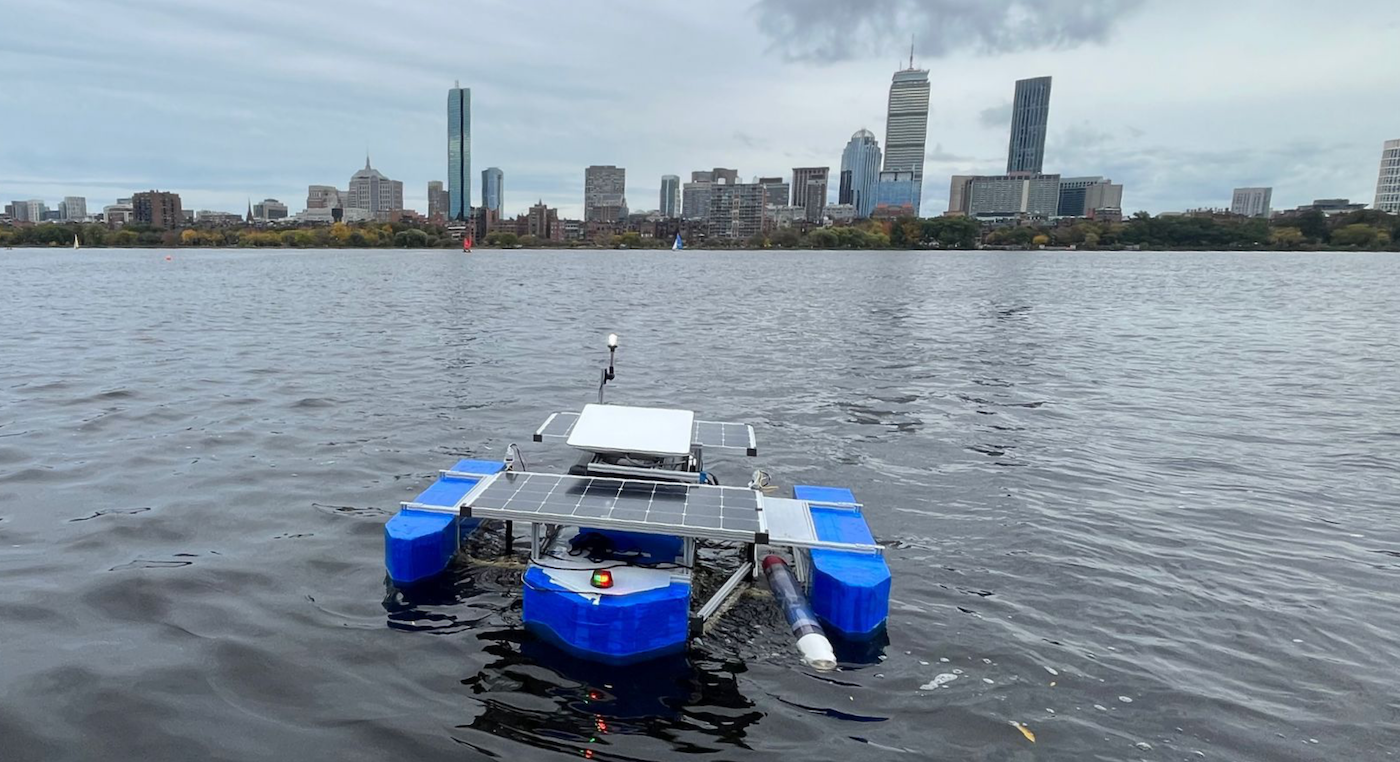
PEARL, the Platform for Expanding AUV Exploration to Longer Ranges, is an autonomous, solar-powered USV docking platform developed at MIT to support long-duration ocean operations. As a floating base for robotic systems, PEARL supports offshore sensing, vehicle docking, communications, and future multi-robot missions. PEARL also leverages the new generation of Low Earth Orbit (LEO) satellite constellations, such as Iridium and Globalstar, with uplink speeds of 10-30 Mbps and downlink speeds exceeding 100 Mbps. Real-time high-speed internet anywhere on the ocean via space is a potential game changer for maritime operations on and under the water.
PEARL is currently being redesigned as a larger and more capable platform, with added power capacity and updated internal layouts informed by field testing. The new design includes structural and electrical provisions for a quadcopter drone port, supporting future launch and recovery, aerial sensing, inspection, charging, and data-transfer operations from a floating marine base. A three-degree-of-freedom motion platform, providing roll, pitch, and heave motion, will support repeatable testing of drone landing, docking, and platform-relative control under representative wave-induced motion. Together, these efforts move PEARL toward a flexible offshore testbed for long-duration ocean monitoring and coordinated surface, aerial, and underwater robotic operations.
Categories:
- USVs
- Mobile Buoys